Hemispherical Photography

Service:  Measure local solar radiation and canopy structure using
hemispherical photography.

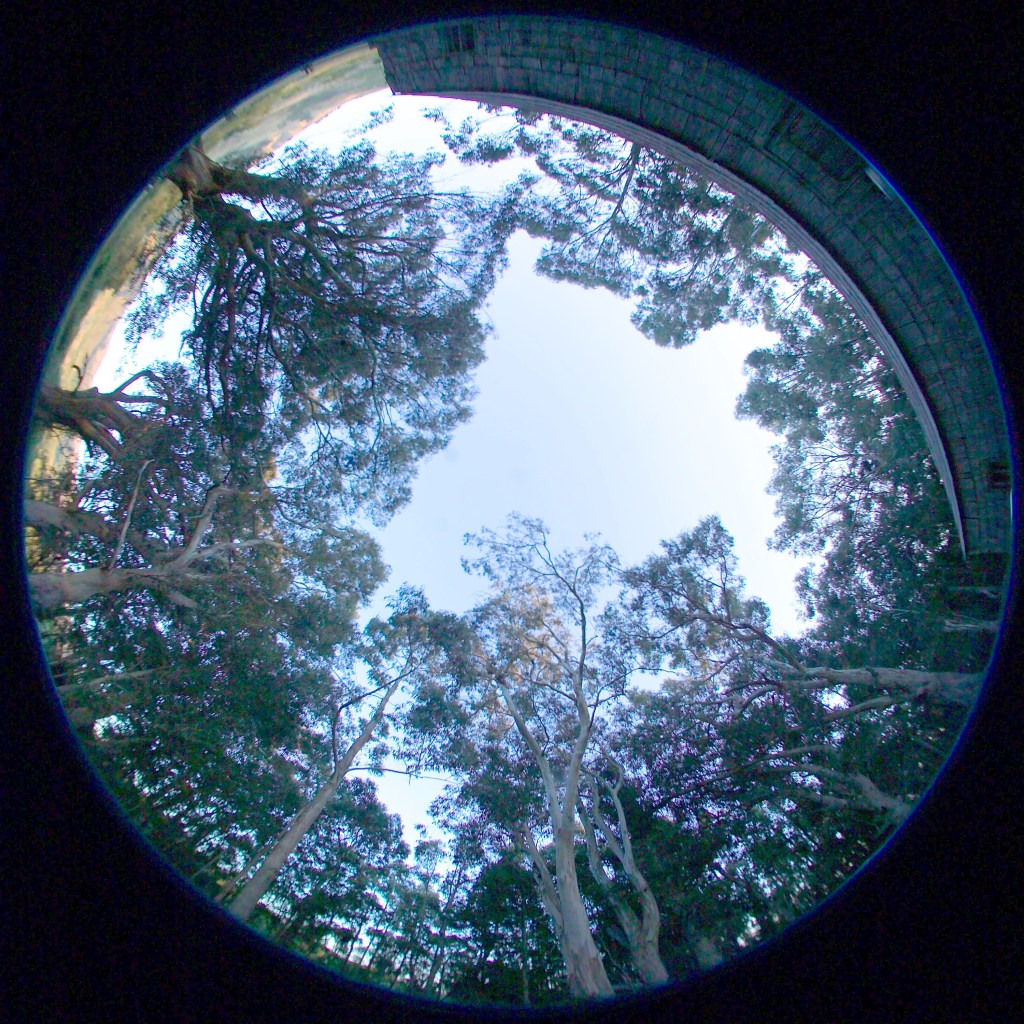
The Technique:  Hemispherical photography, also known as canopy or
fisheye photography, is a powerful technique for calculating light regimes
under plant canopies and for assessing canopy structure.  Hemiphotos
are acquired using a camera fitted with a special wide-angle lens pointed
upwards, providing a 180 degree (hemispherical) view.  The resulting
circular images depict the zenith at the center and the horizons at the
edges.  Using computer image analysis tools we are able to calculate the
direct and diffuse light that penetrates through canopy openings.  We can
also estimate properties of the canopy itself, such as leaf area index (the
area of foliage per unit ground area).

Our Contribution:  Over the years we have contributed to the basic
scientific theory and methods underlying the hemispherical photography
technique, and have applied  the technique to address diverse scientific
and conservation problems.  For example, we have used hemispherical
photography to characterize the winter roosting sites of monarch
butterflies, allowing us to identify critical areas where tree loss reduces
habitat quality.  In another example, we have used the technique to
examine riparian vegetation influences on stream temperature, allowing
us to explore conservation implications of tree removal, riparian
restoration, and climate change.  Recently we have begun using
hemispherical photography to evaluate favorable conditions for producing
quality wine grapes, allowing us to determine appropriate trellis design
for unique conditions of different vineyards.

More Information:  
• Wikipedia Hemispherical Photography article:
  
http://en.wikipedia.org/wiki/Hemispherical_photography
Copyright 2008 © Creekside Center for Earth Observation LLC. All rights reserved.
Creekside Center
for Earth Observation
References

Bellingham, P.J., E.V.J. Tanner, P.M. Rich, and T.C.R. Goodland. 1996. Changes in light below the canopy
of a Jamaican montane rain forest after a hurricane.
Journal of Tropical Ecology 12:699–722.  pdf

Breshears, D.D., P.M. Rich, F.J. Barnes, and K. Campbell. 1997. Overstory–imposed heterogeneity in
solar radiation and soil moisture in a semiarid woodland.
Ecological Applications 7:1201–1215.  pdf

Chen, J.M., P.M. Rich, S.T. Gower, J.M. Norman, and S. Plummer. 1997. Leaf area index of boreal forests:
theory, techniques, and measurements.
Journal of Geophysical Research, BOREAS Special Issue 102(D24):
29429–29444.  
pdf

Clark, D.B., D.A. Clark, and P.M. Rich. 1993. Comparative analysis of microhabitat utilization by saplings
of nine tree species in neotropical rain forest.
Biotropica 25:397–407.  pdf

Clark, D.B., D.A. Clark, P.M. Rich, S.B. Weiss, and S.F. Oberbauer. 1996. Landscape–scale evaluation of
understory light and canopy structure: methods and application in a neotropical lowland rain forest.
Canadian Journal of Forest Research 26:747–757.  pdf

Fournier, R.A., P.M. Rich, and R. Landry. 1997. Hierarchical characterization of canopy architecture for
boreal forest.
Journal of Geophysical Research, BOREAS Special Issue 102(D24):29445–29454.  pdf

Fournier, R.A., P.M. Rich, Y.R. Alger, V.L. Peterson, R. Landry, and N.M. August. 1995. Canopy
architecture of boreal forests: links between remote sensing and ecology.
American Society for
Photogrammetry and Remote Sensing Technical Papers
2:225-235.

Galo, A.T.,
P.M. Rich, and J.J. Ewel. 1992. Effects of forest edges on the solar radiation regime in a
series of reconstructed tropical ecosystems.
American Society for Photogrammetry and Remote Sensing
Technical Papers
. pp 98–108.

Lerdau, M.T., Holbrook, N.M., H.A. Mooney,
P.M. Rich, and J.L. Whitbeck. 1992. Seasonal patterns of acid
fluctuations and resource storage in the arborescent cactus Opuntia excelsa in relation to light
availability and size.
Oecologia 92:166-171.  pdf

Lin, T., P.M. Rich, D.A. Heisler, and F.J. Barnes. 1992. Influences of canopy geometry on near-ground
solar radiation and water balances of pinyon-juniper and ponderosa pine woodlands.
American Society
for Photogrammetry and Remote Sensing Technical Papers
. pp. 285-294.

Oberbauer, S.F., D.B. Clark, D.A. Clark,
P.M. Rich, and G. Vega. 1993. Light environment, gas exchange,
and annual growth of saplings of three species of rain forest trees in Costa Rica.
Journal of Tropical
Ecology
9:511–523.  pdf

Rich, P.M. 1988. Video image analysis of hemispherical canopy photography. In: P.W. Mausel (ed), First
Special Workshop on Videography. Terre Haute, Indiana. May 19-20, 1988,
American Society for
Photogrammetry and Remote Sensing
, pp. 84-95.

Rich, P.M. 1989. A manual for analysis of hemispherical canopy photography. Los Alamos National
Laboratory Report LA-11733-M.  
pdf

Rich, P.M. 1990. Characterizing plant canopies with hemispherical photographs. In: N.S. Goel and J.M.
Norman (eds), Instrumentation for studying vegetation canopies for remote sensing in optical and
thermal infrared regions.
Remote Sensing Reviews 5:13-29.  pdf

Rich, P.M., D.A. Clark, D.B. Clark, and S.F. Oberbauer. 1993. Long–term study of solar radiation regimes
in a tropical wet forest using quantum sensors and hemispherical photography.
Agricultural and Forest
Meteorology
65:107–127.  pdf

Rich, P.M., R. Dubayah, W.A. Hetrick, and S.C. Saving. 1994. Using viewshed models to calculate
intercepted solar radiation: applications in ecology.
American Society for Photogrammetry and Remote
Sensing Technical Papers
. pp 524–529.  pdf

Rich, P.M., D.M. Ranken, and J.G. George. 1989. A manual for microcomputer image analysis. Los Alamos
National Laboratory Technical Report LA–11732–M.  
pdf

Rich, P.M., J. Chen, S.J. Sulatycki, R. Vashisht, and W.S. Wachspress. 1995. Calculation of leaf area
index and other canopy indices from gap fraction: a manual for the LAICALC software. Kansas Applied
Remote Sensing Program Open File Report. Lawrence, KS.  
pdf

Rich, P.M., J. Wood, D.A. Vieglais, K. Burek, and N. Webb. 1999. Guide to HemiView: software for
analysis of hemispherical photography. Delta–T Devices, Ltd., Cambridge, England.  
pdf

Rich, P.M., N.M. Holbrook, and N. Luttinger. 1995. Leaf development and crown geometry of two
iriarteoid palms.
American Journal of Botany 82:328–336.  pdf

Shaw, D.C., and S.B. Weiss. 2000. Canopy light and the distribution of hemlock dwarf mistletoe
(Arceuthobium tsugenses [Rosendahl] G.N. Jones subsp. tsugense) aerial shoots in an old-growth
Douglas-fir/western hemlock forest.
Northwest Science 74:306-315.  pdf

Weiss, S.B. 2000. Vertical and temporal patterns of insolation in an old-growth forest. Canadian Journal
of Forest Research
30:1953-1964  pdf

Weiss, S.B., P.M. Rich, D.D. Murphy, W.H. Calvert, P.R. Ehrlich. 1991. Forest canopy structure at
overwintering monarch butterfly sites: measurements with hemispherical photography.
Conservation
Biology
5:165-175.  pdf

Weiss, S.B., and D.C. Luth. 2002. Assessment of overwintering monarch butterfly habitat at Cooper
Grove (Andrew Molera State Park, Monterey County, CA) using hemispherical photography. Creekside
Center for Earth Observation Report, Menlo Park, CA.  
pdf

Weiss, S.B., D.C. Luth, and B. Guerra. 2003. Potential solar radiation in a VSP trellis at 38°N latitude.
Practical Winery and Vineyard 25:16-27.  pdf

Weiss, S.B., et al. 2005. Topoclimate and microclimate in the Monarch Butterfly Biosphere Reserve
(Mexico). World Wildlife Fund Project. Creekside Center for Earth Observation Report, Menlo Park, CA.  
pdf
Hemispherical photograph used to
study microclimate of winter
roosting habitat at the Monarch
Butterfly Biosphere Reserve,
Mexico (photo by S. Weiss).
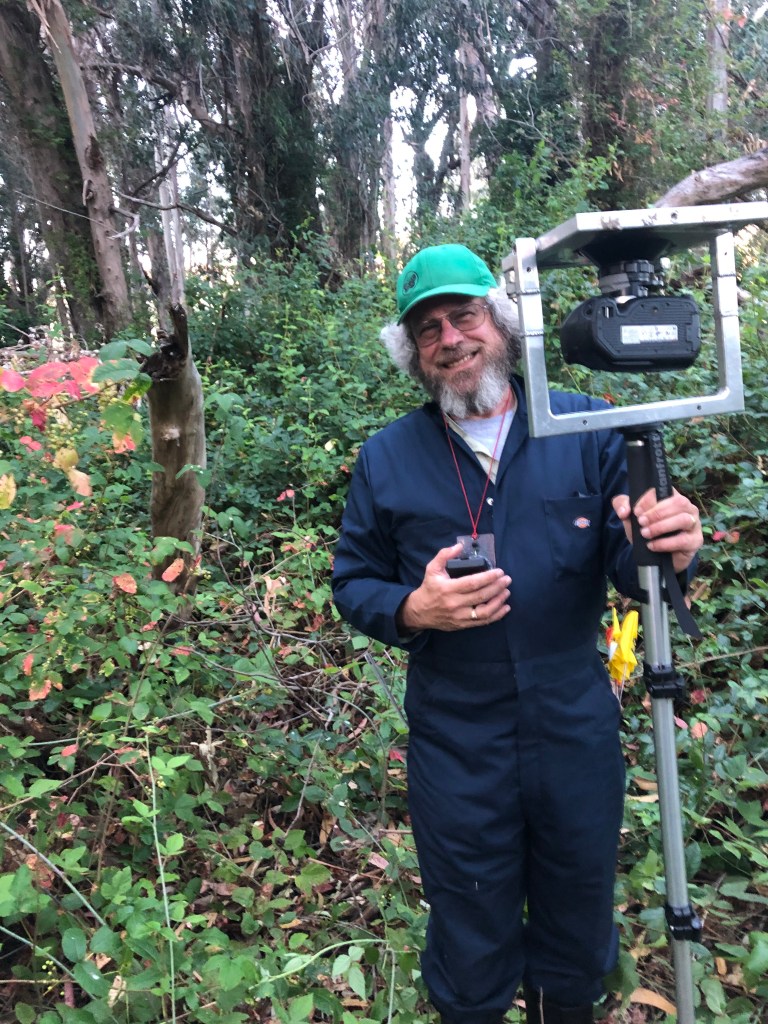
Hemispherical photographs being
acquired to assess conditions for
grape ripening in vineyards  
(photo by S. Weiss).
Stream reaches with closed-canopy (left) versus open-canopy (right)
riparian vegetation have markedly different temperature regimes .